

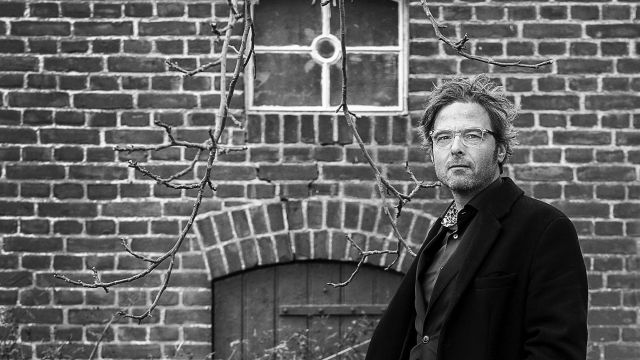
Writer Bas Steman searches for the soul of Kampen
Telling the story of a city through archaeological finds calls for imagination. And that is what I ask of the reader or listener on the city walk. I look for the voice of the city, of the cog, of a forgotten alley or a demolished city gate. That is how I try to bring the history of Kampen to life.
Writer Bas Steman
About the writer Bas Steman
Writer Bas Steman has some six books to his name, including an experiential biography about (and with) Ramses Shaffy. His most recent novel is ‘De Lafaard’, a rural epic about two brothers who have lived on their parents’ farm in the east of the Netherlands all their lives. They find it hard to keep up with modern times. They share joys and sorrows with each other, except for their wartime past. ‘It is a humorous, melancholy and poetic book about the decline of the countryside, but also about how our parents and grandparents preferred not to talk about the war. Not about what really happened. My novels are often about longing, beauty and what passes.’
His best-known work is the novel ‘Morgan, een liefde’ (2018), which brought him many appearances on radio and television. Adriaan van Dis praised this moving and inimitable story about the love of a paratrooper who is killed in the Battle of Arnhem. The novel received glowing reviews and is now in its fourteenth printing. ‘It is above all the elusive, somewhat controversial underlying story and the deep love that continue to move readers,’ says Steman:
‘It was quite daring to write this book, and now it is an ‘everseller’, as they say. The broadcast on De Verwondering last year stirred up a lot. The book is almost seven years old and people still bring it up with me every week.’
In recent years his poetic pen has been much in demand to tell the stories of cities and of museum exhibitions, such as for the Stevenskerk in Nijmegen and the Oorlogsmuseum Overloon. In 2020 he wrote the text for the Freedom Fire at the national commemoration in Wageningen, and he created ‘Suelle’, the Hanseatic history of Zwolle, for the Hanze Experience that could be seen in the Academiehuis last year. Recently an audio tour he wrote was unveiled near Oosterbeek, about the escape of British soldiers across the Rhine in September 1944.
‘History has always interested me. For Omroep Gelderland I make a history programme, ‘Ridders van Gelre’. Too often it is all about the history of Holland. That is fine too, but it tells a different story from ours, here, in the east. Here, for example, the Middle Ages were a time of economic and cultural flourishing, and the Eighty Years’ War was fought out here. Knowing your story, the history of your surroundings, makes you look at yourself with different eyes, at your origins, at the story you live in. That I may look into the soul of a beautiful old city like Kampen and capture it in stories is an honourable task.’
In the ten short Kampen stories he has written, he plays with language and perspective, bringing the history of the city to life in surprising ways: ‘I am an artist, a writer. Do not expect Wikipedia texts from me.’